Becoming Monster Workshop Certified
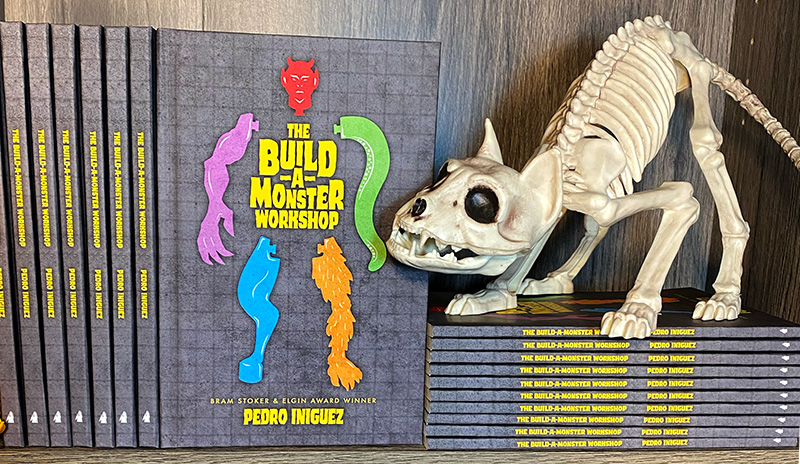
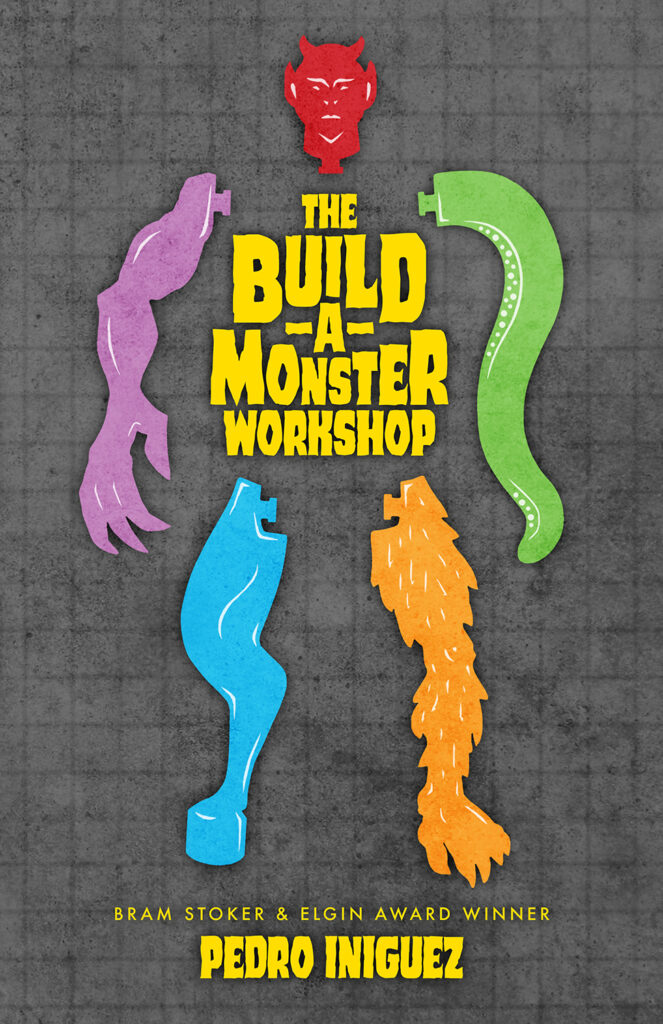
Peter Atkins has authored novels, screenplays (including Hellraiser II-IV) and short fiction but I was surprised when Pedro suggested him for the Introduction of The Build-A-Monster Workshop poetry collection. What could this guy have to say about poetry? Well actually he had a lot to say about it and I loved his take. Here’s why you should read this book regardless of whether you’re a horror fan or a poetry devotee:
Introduction to The Build-A-Monster Workshop:
Man, this guy Iniguez is asking for trouble.
Horror poetry? Horror poetry?! I mean, that’s two strikes before he even picks up the bat, the first coming courtesy of those literary snobs who believe that horror is for mouth-breathing heavy metal illiterates, and the second—every bit as annoying—courtesy of the inverted snobs, those fans of horror (or popular fiction in general) who believe that poetry is for airy-fairy intellectual poseurs. But here comes Pedro anyway, dauntless and unafraid, stepping up to the plate and taking his swing.
Now look, if you’re one of the tiny percentage of people who already like horror poetry, who already know that it’s a perfectly viable and exciting sub-genre of the fantastique that’s actually kind of been having a moment for the last couple of decades, then you need waste no further time on my nonsense; Pedro’s excellent work awaits you, and I promise I won’t be offended if you bail on me right now and go jump straight in to enjoy it. But if you’re not one of those people, if you’re instead one of those people who like poetry but are far from sure about this horror shit or one of those people who like horror but are a bit leery of poetry and its pretensions, then bear with me for a moment or two.
First, for you people who like poetry but aren’t entirely convinced that it should be dirtying its dainty little hands with blood, guts, and gore, it might be time for a quick history lesson. Horror poetry has always been with us. And I’m not talking about the work of johnny-come-latelys like Edgar Allan Poe or Howard Phillips Lovecraft. When I say always, I mean always. Since the very beginning of literature, since before it was even written down, horror has been a ubiquitous presence in poetry. There are monsters in The Iliad. There are monsters in Beowulf. Oedipus, when he’s not busy having sex with his mom or killing his dad, has a memorable run-in with the Sphinx. And the greatest poets of the western literary canon, especially the Romantics, have all had a shot at it. Samuel Taylor Coleridge not only wrote The Rime of the Ancient Mariner (packed with apparitions, supernatural curses, and incarnations of Death and Life-in-Death tossing dice for human souls) but can also lay claim to inventing the literary vampire: A century before Dracula and a good seventy years before Sheridan Le Fanu’s Carmilla, Coleridge gave us Christabel, and he gave it to us in verse. Keats wrote Lamia and La Belle Dame Sans Merci. Tennyson wrote The Lady of Shallot. Browning wrote Childe Roland to the Dark Tower Came (yeah, that Dark Tower—why’d you think Stephen King called his protagonist Roland?) Even Shakespeare—who, in case you weren’t paying attention, wrote almost exclusively in verse—gave us ghosts and witches and spirits (not to mention demonic half-breeds like Caliban, who’s not only the child of a sea witch but who could also be said to be a product of the magician Prospero’s very own Build-A-Monster workshop).
So get the fuck over yourselves and realize that horror not only deserves a place at poetry’s table but arguably gets to sit at the head.
Now, as for you horror fans…
Look, I get it. You like horror. You like horror fiction. You like horror movies. You like horror comics. You may even be hardcore enough to collect monster model kits or action figures. You might very well have the good taste to already be a fan of Pedro’s own horror stories. You’re just not sure about this poetry thing. In fact, to tell the truth, you might actually be a little bit afraid of it. You probably avoided it like the plague at High School, in no small part because you weren’t entirely sure how to read it. Who can blame you? It looked weird. Too much white space on the page. Too many fragments and half-sentences. Bits that rhyme, bits that don’t, like nobody’s actually in charge. I hear you. So I’m going to let you in on a little secret about poetry: You should do yourself a favor and read it aloud.
Okay, calm down. If you’re in an office or a public library, it doesn’t have to be literally aloud. But the thing about poetry—about any worthwhile writing, to be honest, but especially about poetry—is that it’s sensual. It’s as much about the music as it is the meaning. You need to feel the words in your mouth, to taste them, to feel their shape and their weight and, perhaps most importantly, their rhythm. Poetry began as song, and that’s still its secret heart.
Pedro Iniguez is a dynamo, and one who apparently refuses to recognize boundaries. He doesn’t have a lane, and he ain’t staying in it. He has written science fiction, fantasy, and horror. He has written novels, short stories, novellas, and children’s books. His output is both prodigious and critically acclaimed. He is also already a prize-winning poet (which is great news for you in case you were still hedging your bets).
Pedro has the music in him. He might not be a slave to a strict syllable-counting formality of line, but he always feels—and is always in command of—the metrical pulse beneath, even when he’s free-forming. It might be bebop rather than swing, but it’s still got a beat. And his eye is as good as his ear; whether he’s delivering a tiny bejeweled haiku or a longer event-driven narrative, the precision of his language ensures that we, as readers, always know where we are and what we’re looking at. Sometimes we mightn’t want to be looking at it—Pedro isn’t someone to shy away from the grotesque or the grand guignol—but every image lingers, as does every emotion evoked.
I’m going to leave you to enjoy it now. You’re in safe hands. Well, I say safe. Don’t get too comfortable. At least one of those hands could have something sharp in it…
Peter Atkins
Los Angeles, February 2026
Peter Atkins is the author of the novels Morningstar, Big Thunder, and Moontown and the screenplays Hellraiser II, Hellraiser III, Hellraiser IV, and Wishmaster. His short fiction has appeared in such anthologies as The Museum of Horrors, Dark Delicacies II, Hellbound Hearts, and Ghosts, and has been selected eight times for one or more of the various “Year’s Best” anthologies. His collection, Rumors of the Marvelous, was a finalist for the British Fantasy Award.